
The School Bell Rings
The school bell rings, the day begins,
With eager hearts and happy grins.
The hallways hum with voices loud,
As every student gathers ’round.
Books and pencils, ready to go,
Learning new things, we start to grow.
From math to science, history, too,
Every lesson brings something new.
Teachers guide with patient hands,
Helping us to understand.
Through ups and downs, we always try,
With dreams and hopes that touch the sky.
The school is where we learn to soar,
Exploring knowledge, opening doors.
With friends beside us, we are strong,
Together we’ll go on and on.
The bell will ring, the day will end,
But what we’ve learned will never bend.
School’s a place where dreams take flight,
A place of wonder, shining bright.
what to consider when writing a poem about the school
When writing a poem about school, here are a few things to consider:
- Theme and Purpose:
Decide on the message or feeling you want to convey. Is it about the joy of learning, the challenges, the friendships, or the routine of school life? Your theme will guide the tone of the poem. - Audience:
Consider who will be reading the poem. Is it for children, teachers, or a broader audience? The complexity of language and imagery can vary depending on this. - Tone and Emotion:
Think about the emotional response you want to evoke. Should the poem be playful, nostalgic, inspiring, or reflective? The tone will influence the word choice and structure. - Setting and Imagery:
Use vivid descriptions of the school environment—classrooms, hallways, playgrounds, etc. Engage the reader’s senses with sounds (e.g., the bell ringing), sights (e.g., colorful walls), and even smells (e.g., fresh notebooks). - School Experience:
Reflect on the daily school experiences: interactions with classmates, teachers, lessons, recess, homework, or sports. Think about the elements that make school unique to you.

- Structure and Form:
Decide whether you want to follow a traditional structure (like a rhymed or fixed pattern) or go for free verse, where you have more flexibility. The rhythm can play a big role in how the poem feels when read aloud.

- Word Choice:
The choice of words is important for setting the tone. Simple words may evoke innocence, while more complex ones can bring depth or a sense of maturity. Consider metaphors, similes, or other figures of speech to enhance the imagery. - Personal Experience or Universal Themes:
You can either write from personal experience, sharing specific memories, or tap into universal school experiences that most people can relate to, like first days, friendships, or learning milestones. - Flow and Rhythm:
Pay attention to the flow of the poem. Even if it’s not strictly formal, the rhythm should feel natural to make the poem enjoyable to read. You might want to read it out loud to see how it sounds. - End with Reflection or Message:
Many poems about school have a reflective ending that ties back to the theme, like a personal lesson learned, the importance of education, or the value of friendship.
By weaving these elements together, you can create a meaningful and engaging poem about the school experience.
a goodbye poem to school at graduation

A Farewell to School
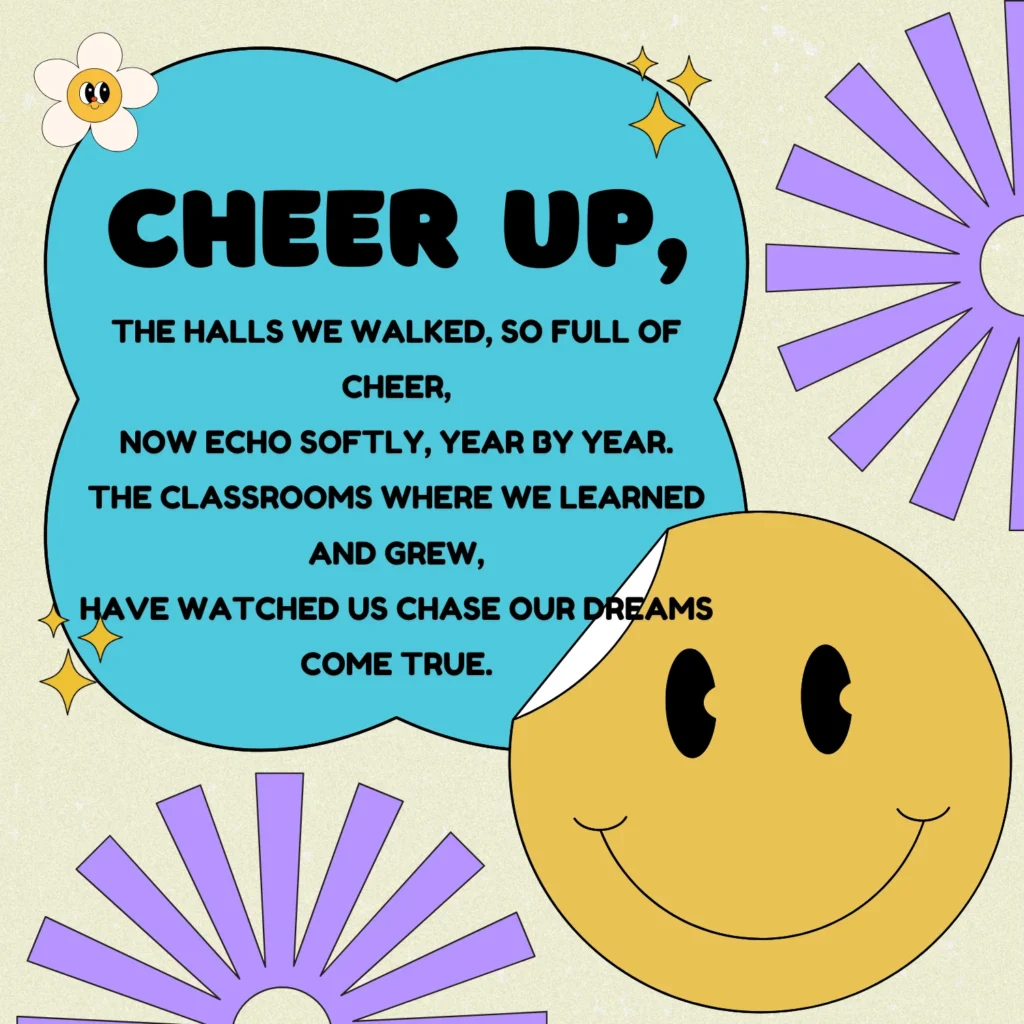
The halls we walked, so full of cheer,
Now echo softly, year by year.
The classrooms where we learned and grew,
Have watched us chase our dreams come true.
The laughter shared, the friendships made,
The lessons learned that never fade,
Through every test and every try,
We found the courage to reach the sky.

The morning bell, the ringing sound,
That called us here, now fades around.
We’ve reached the end, but not the start,
For school will live inside our heart.
Though we may leave and walk away,
The memories will always stay.
The steps we took, the paths we’ve paved,
All of it, a journey brave.
So here’s goodbye, but not farewell,
For in our hearts, you’ll always dwell.
To teachers, friends, and every year,
We thank you for being near.
The future waits with arms held wide,
And we are ready, full of pride.
With all we’ve learned and all we’ve shared,
We leave, but know we’ll always care.
Goodbye, dear school, and thank you, too,
For everything we’ve learned to do.
Now we step forward, on our way,
But in our hearts, you’ll always stay.
a poem about school – for kids
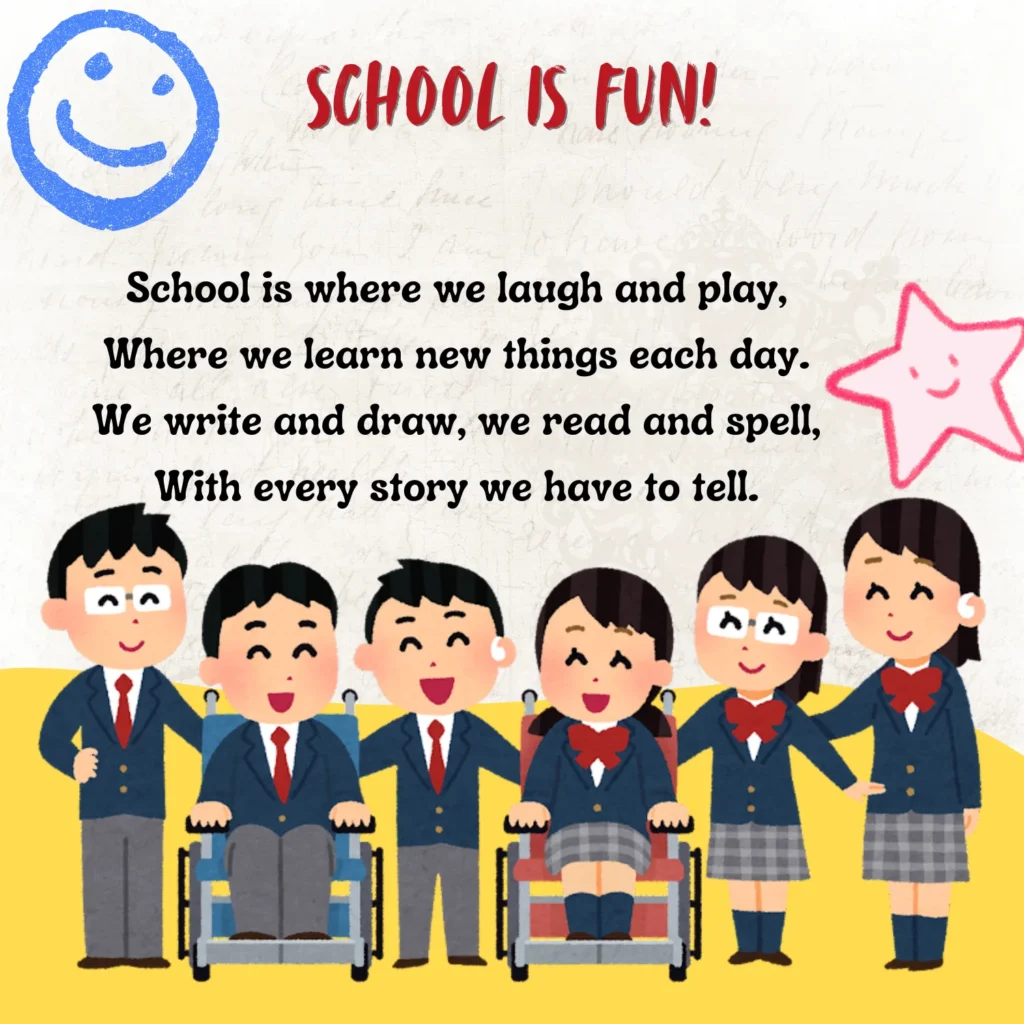
School is Fun!
School is where we laugh and play,
Where we learn new things each day.
We write and draw, we read and spell,
With every story we have to tell.
The bell rings loud, it’s time to start,
Learning with our heads and heart.
In math, we count, in science we see,
The world is full of mystery!
The playground’s where we run and race,
With smiles and giggles on each face.
We climb the slides, and jump so high,
Chasing dreams beneath the sky.
Teachers guide us, kind and bright,
Helping us to do things right.
We ask questions, big and small,
In school, we learn to do it all!
With books and friends, and endless fun,
School’s a place where we’ve just begun.
Every day’s a new adventure, too—
So much to learn, so much to do!
a poem about a day in school
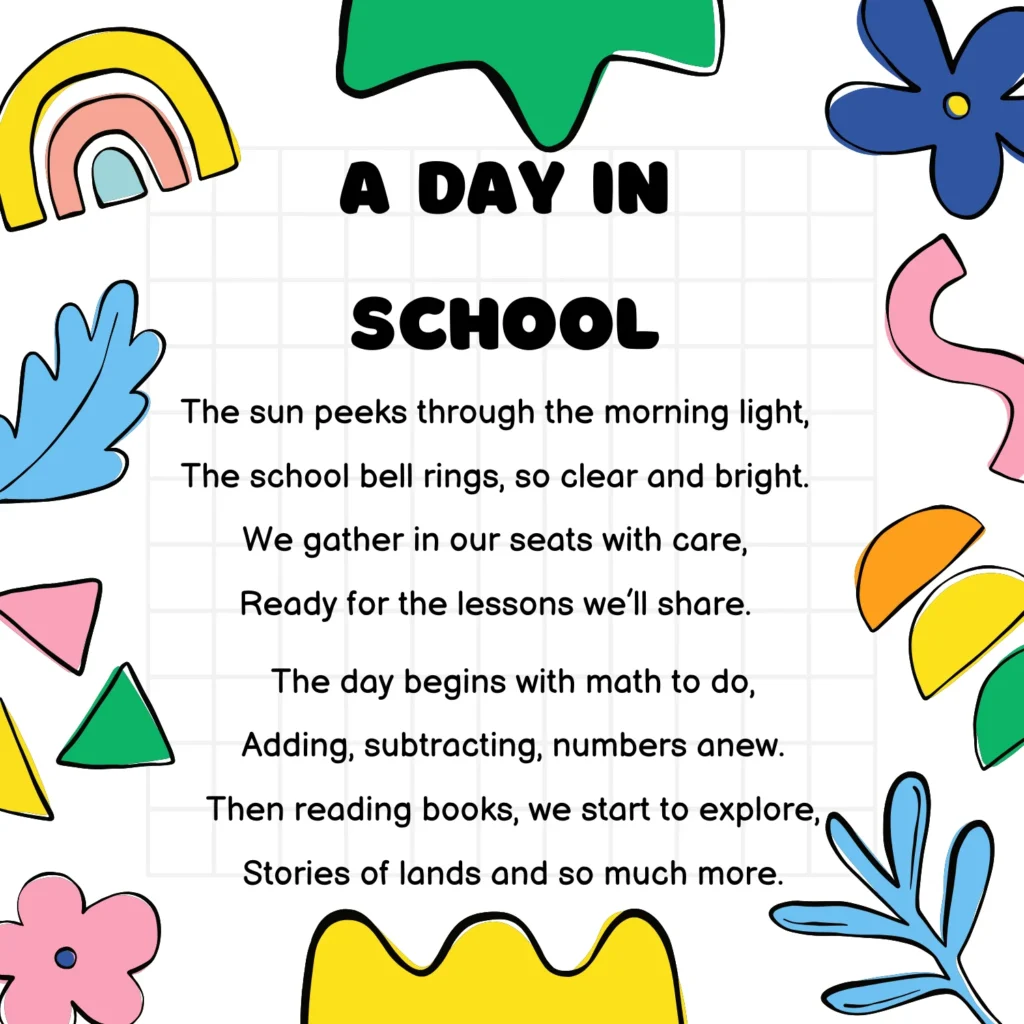
A Day in School
The sun peeks through the morning light,
The school bell rings, so clear and bright.
We gather in our seats with care,
Ready for the lessons we’ll share.
The day begins with math to do,
Adding, subtracting, numbers anew.
Then reading books, we start to explore,
Stories of lands and so much more.
Recess time! We run outside,
To swing and slide, and take a ride.
Laughter echoes, fun and free,
In the playground, happy as can be.
Back inside for science to learn,
How plants grow and the stars that turn.
Then we write with pens in hand,
Creating stories, taking a stand.
Lunch arrives with tasty treats,
We share our snacks, enjoy the eats.
Chatting with friends, we laugh and play,
Talking about the fun of the day.
The afternoon brings lessons anew,
Learning about the world we view.
Art and music, drawing and song,
Where every kid can sing along.
The bell rings loud, the day is done,
We’ve learned and laughed and had our fun.
A day at school, full of cheer,
Can’t wait to come back tomorrow, dear!
School as a Universal Human Experience
Almost everyone has been to school, and almost everyone carries a complex relationship to that experience. School is where we first encounter formal learning, make our earliest friendships (and enemies), discover our capabilities and our limitations, navigate social hierarchies for the first time, and begin to understand who we are in relation to others. This richness of experience makes school an extraordinary subject for poetry — universally recognisable, yet intensely personal for each writer.
Poetry about school spans a remarkable emotional range. There are poems of joy — the excitement of discovery, the thrill of understanding something new, the warmth of a favourite teacher. There are poems of dread — the anxiety of the playground, the fear of failure, the loneliness of not fitting in. And there are poems of nostalgia — the bittersweet look back at a time that seemed difficult then but now appears, through the lens of adult perspective, with a particular golden light.
How to Experience and Appreciate Poetry About School
Reading poems about school, you will find that your own school memories become active. This is one of the ways poetry works: it uses a shared subject to unlock individual experience. Pay attention to which details in the poem match your own memories and which are different — the differences are often as revealing as the similarities. A poem set in a school very different from yours can expand your understanding of other people’s childhood experiences in ways that straight memoir or fiction cannot.
Notice the temporal complexity in school poetry. Poets writing about school are always operating in at least two time zones simultaneously: the remembered past (the child in the classroom) and the reflecting present (the adult who is writing). How these two time zones relate to each other — whether with tenderness, irony, grief, or wonder — shapes the whole emotional texture of the poem. The most interesting school poems resist simple nostalgia, holding both the difficulty and the beauty of that time.
The Literary Tradition of School Poetry
The school poem has a long tradition. Thomas Hardy wrote about a schoolroom and the echo of voices from the past. Dylan Thomas’s “Fern Hill” captures the freedom of a childhood before formal education claimed it. Seamus Heaney wrote beautifully about his experiences in rural Irish schools in the 1950s, grounding the poems in specific sensory detail — the smell of chalk, the sound of rain on school windows, the texture of wooden desks.
In more recent times, poets from diverse backgrounds have used school as a setting for exploring wider social questions — about class, race, gender, and the purposes of education. Benjamin Zephaniah’s poetry about a school system that failed him and children like him is both angry and compassionate. These poems ask not just what school was like but what it was for and for whom — questions as urgent now as they have ever been.
Literary Devices That Capture School Life in Poetry
The school poem often uses sensory detail with particular precision — the specific sounds of a school (chalk on blackboard, the bell, voices in a corridor), the particular smells (floor polish, school dinners, pencil shavings), the textures of school objects (the smoothed wood of an old desk, the weight of a schoolbag). These details are instantly evocative and establish the poem’s authenticity.
Dramatic monologue — speaking in the voice of the child, or of a teacher, or of an outsider — allows poets to inhabit school experience from different angles. Irony works powerfully in school poetry, particularly when the adult speaker looks back on childhood with knowledge the child did not have. Time shifts — moving between past and present within a single poem — can create a sense of how the past lives on in the present, how who we were at school is still part of who we are now.
What School Poetry Teaches Us
Poetry about school teaches us to value what education does at its best — not just the transmission of information but the opening of a mind, the discovery of one’s own capacity for thought and creativity, the encounter with other minds through literature. It also teaches us to be honest about what education does at its worst: the narrowing of imagination, the reinforcing of hierarchies, the failure to reach certain children.
Most importantly, school poetry teaches us that childhood experience is formative and worth taking seriously — that what happens in classrooms and playgrounds shapes people profoundly. These poems validate the child’s perspective, taking seriously the emotions and experiences that adults sometimes dismiss as trivial. In doing so, they cultivate empathy for children — and for the children we ourselves once were.