
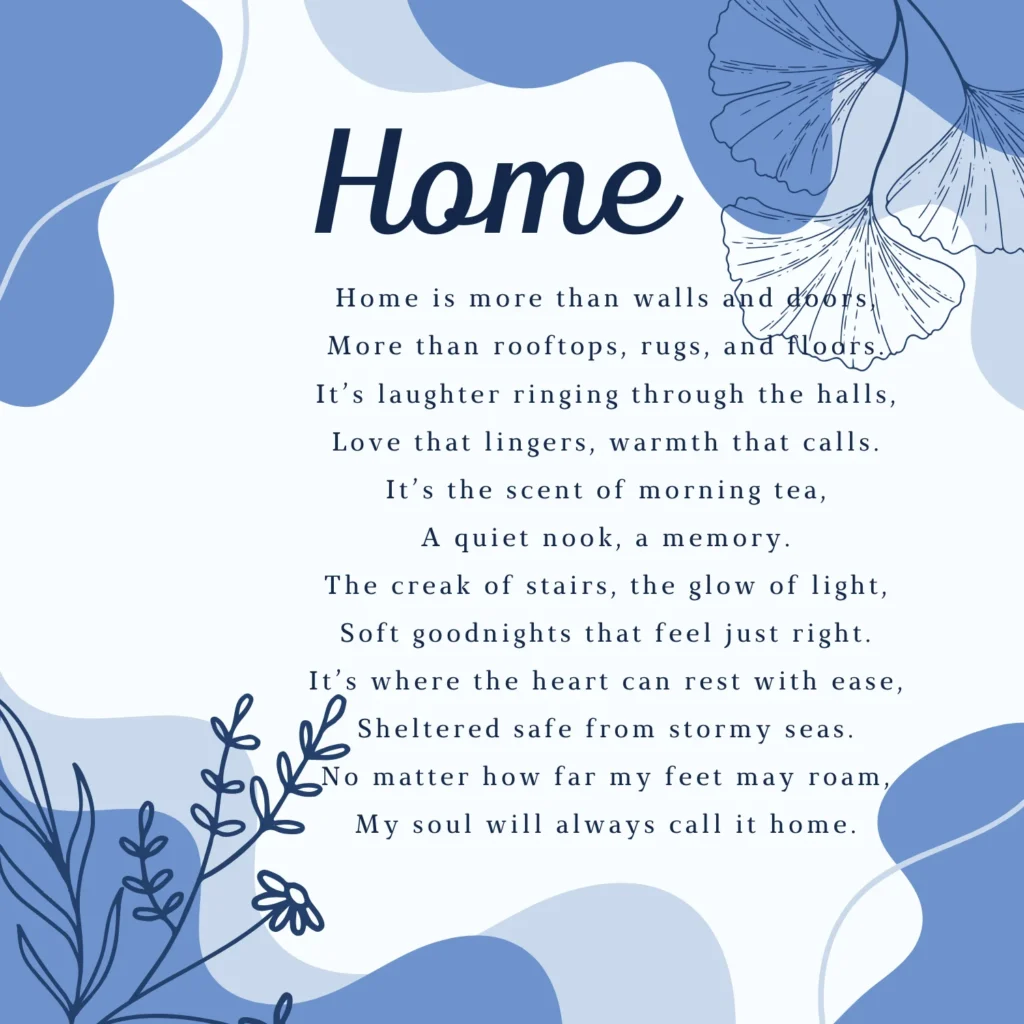
Home
Home is more than walls and doors,
More than rooftops, rugs, and floors.
It’s laughter ringing through the halls,
Love that lingers, warmth that calls.
It’s the scent of morning tea,
A quiet nook, a memory.
The creak of stairs, the glow of light,
Soft goodnights that feel just right.
It’s where the heart can rest with ease,
Sheltered safe from stormy seas.
No matter how far my feet may roam,
My soul will always call it home.
how to write a poem about home?



Writing a poem about home can be deeply personal and emotional. Here’s a step-by-step guide to help you craft one:
1. Identify What “Home” Means to You
- Is home a physical place, a feeling, or the people around you?
- Does it bring warmth, nostalgia, or even longing?
- Think about sights, sounds, and scents that remind you of home.
2. Choose a Tone and Style
- Nostalgic & Warm: Focus on happy memories and comforting details.
- Reflective & Deep: Explore what home truly means beyond a physical space.
- Melancholic & Yearning: Write about missing home or searching for a sense of belonging.
3. Use Sensory Details
- Sight: The flickering of candlelight, the old rocking chair.
- Sound: The hum of a kettle, the laughter of family.
- Smell: Freshly baked bread, the scent of rain on the windows.
- Touch: The soft embrace of a blanket, the warmth of a loved one’s hand.
4. Experiment with Structure & Rhyme (or Free Verse)
- Rhyming: “Home is where the heart will stay, / Through night and dawn, come what may.”
- Free Verse: “Home is the quiet hum of the night / The gentle echo of my mother’s voice.”
5. Express Emotion
- How does home make you feel? Safe? Inspired? Longing for something?
- Use metaphors: “Home is a lighthouse guiding me back.”
- Use repetition for emphasis: “Home is love. Home is warmth. Home is where I belong.”
6. Edit and Refine
- Read it out loud to check the rhythm and flow.
- Remove unnecessary words but keep the emotional depth.
small poems about home
short poems about home:
1.
Home is where the heart finds peace,
A quiet place where worries cease.
Where love and warmth are always near,
And every day feels crystal clear.
2.
The door creaks open, soft and slow,
A place to rest, a place to grow.
Home is more than just a space—
It’s where you find your special place.
3.
Home is where the kettle sings,
Where laughter soars and joy it brings.
A cozy nook, a soft embrace,
A gentle, loving, familiar space.
4.
A simple chair, a wooden floor,
Home’s not a house, but so much more.
It’s where the heart can always stay,
No matter where you go each day.
5.
Home is where the stars shine bright,
Where dreams take off in silent flight.
A world of comfort, calm, and care—
A refuge found in every prayer.
acrostic poems for home
Here are a few acrostic poems for “HOME”:
1.
Holding memories in each room,
Open arms that chase the gloom.
Moments cherished, hearts that gleam,
Everlasting love, a steady beam.
2.
Haven of peace, where hearts align,
Open doors, a love divine.
My safe place, forever true,
Every part of it feels new.
3.
Hopeful mornings filled with light,
Old and new, hearts shining bright.
Melodies of laughter flow,
Ever warm, where love will grow.
4.
Holding all the dreams we keep,
Offering comfort, calm, and sleep.
Made of moments, big and small,
Every corner feels like home to all.
Why Home Is One of Poetry’s Most Enduring Themes
Home is one of the deepest concepts in human experience. It is not just a place — it is a feeling, a memory, a longing, a sense of belonging. It is where we became who we are, and sometimes a place we can never fully return to. This complexity makes home a uniquely rich subject for poetry. Poets return to it again and again because it holds so much: childhood, love, loss, identity, safety, and exile.
The best poems about home do not simply describe a physical place. They capture what a home means — the smell of a kitchen, the sound of a voice, the feeling of being known. They explore the tension between the home we have and the home we long for, between where we come from and where we belong. These poems touch something universal because everyone, regardless of background, understands the need to belong somewhere.
How to Experience and Appreciate Poems About Home
When reading a poem about home, bring your own memories to the text. Notice what details the poet chooses — which objects, which rooms, which sounds. These specific details are not random; they carry the emotional weight of the whole poem. A poet who mentions a cracked windowpane or a particular chair is pointing to something that holds meaning. Your job as a reader is to ask: why this detail? What does it represent?
Notice also the tone: is it nostalgic, grieving, celebratory, or ambivalent? Poems about home often hold multiple emotions at once — love and loss, warmth and longing. Sit with that complexity. The poems that resist easy resolution are often the most true to life, because our relationship with home is rarely simple or uncomplicated.
The Literary Tradition of Home in Poetry
From Homer’s Odyssey — which is essentially a long poem about the desperate need to get home — to Warsan Shire’s contemporary verses about displacement and belonging, home has always been at the heart of literature. Robert Frost wrote of home as a place where “when you have to go there, they have to take you in.” Seamus Heaney’s poetry is saturated with the sensory world of his Northern Irish childhood. Maya Angelou explored what home meant for Black Americans navigating a country that often denied them belonging.
In diasporic literature, the poem about home takes on particular power. Writers like Warsan Shire, Ocean Vuong, and Claudia Rankine explore what it means to carry home inside yourself when you can no longer return — or when the place you came from has changed beyond recognition. These poems expand our understanding of what home means and who gets to feel at home in the world.
Literary Devices That Bring Home Poetry to Life
Sensory imagery is the most powerful tool in home poetry. The sights, sounds, smells, and textures of a specific place anchor the poem in physical reality and trigger emotional memory. Synesthesia — mixing senses, as in describing a sound as a colour — can create vivid effects. Metaphor transforms the home into something larger: a refuge, a prison, a country, a person.
Nostalgia and elegy (the expression of grief for what is lost) are common tones in home poetry, as are irony and ambivalence. Repetition of key words or images builds emotional resonance. The most effective home poems often circle back to the same image or line with new meaning — the return home mirrored in the return of language.
What Poems About Home Teach Us
Poetry about home teaches us that place shapes identity. Where we grow up, what surrounds us in childhood, who lives alongside us — all of this becomes part of who we are. It teaches us to value the ordinary: the routines, the objects, the voices that make a place feel like home. And it teaches us empathy for those who have lost their homes, been displaced, or never had a place where they fully belonged.
Ultimately, poems about home remind us that belonging is a fundamental human need. They make us cherish what we have, grieve what we have lost, and understand more fully what others are searching for when they seek a place to call home.