
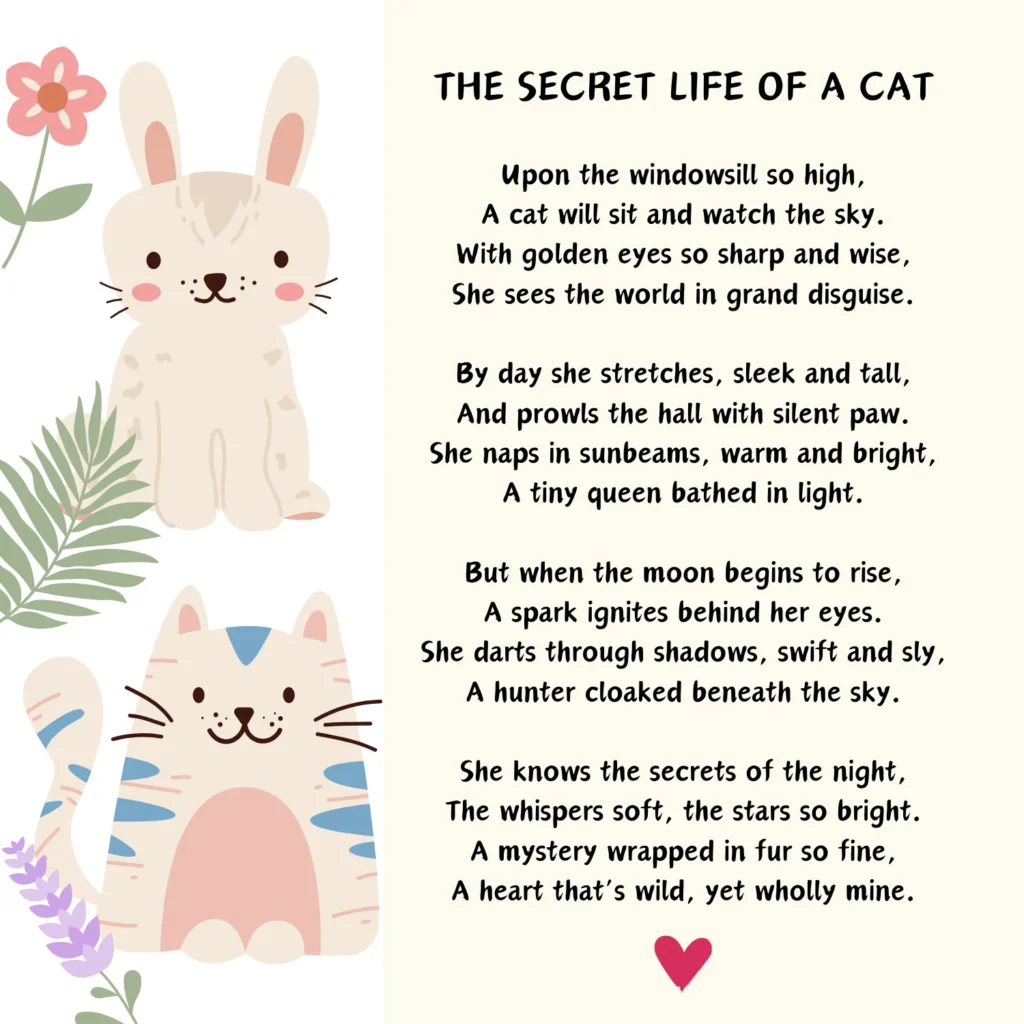
The Secret Life of a Cat
Upon the windowsill so high,
A cat will sit and watch the sky.
With golden eyes so sharp and wise,
She sees the world in grand disguise.
By day she stretches, sleek and tall,
And prowls the hall with silent paw.
She naps in sunbeams, warm and bright,
A tiny queen bathed in light.
But when the moon begins to rise,
A spark ignites behind her eyes.
She darts through shadows, swift and sly,
A hunter cloaked beneath the sky.
She knows the secrets of the night,
The whispers soft, the stars so bright.
A mystery wrapped in fur so fine,
A heart that’s wild, yet wholly mine.
cute poem about cat
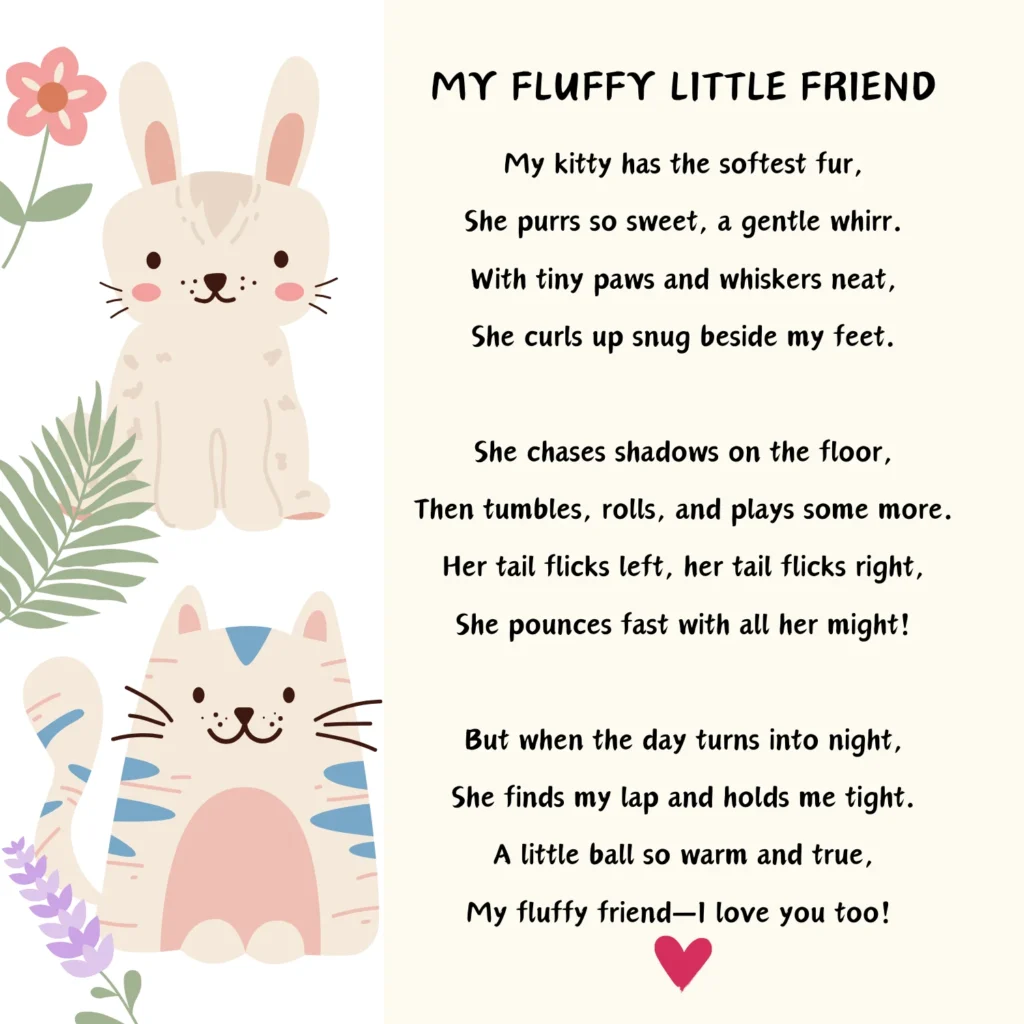
My Fluffy Little Friend
My kitty has the softest fur,
She purrs so sweet, a gentle whirr.
With tiny paws and whiskers neat,
She curls up snug beside my feet.
She chases shadows on the floor,
Then tumbles, rolls, and plays some more.
Her tail flicks left, her tail flicks right,
She pounces fast with all her might!
But when the day turns into night,
She finds my lap and holds me tight.
A little ball so warm and true,
My fluffy friend—I love you too! 💕🐾
sad poem – a goodbye to a cat
Goodbye, My Little Star
I held you close, so soft, so small,
But now the house feels bare and tall.
The echoes of your gentle purr,
Still linger where you used to stir.
Your paws once danced upon the floor,
Now silent steps come here no more.
The sunbeam waits—your favorite place,
Yet finds no whiskered, sleepy face.
I search for you in shadows deep,
In dreams where memories softly creep.
But though you’re gone, I feel you near,
A love that time can’t steal or tear.
So rest, my dear, beneath the sky,
A tiny star still shining high.
And when the night is calm and true,
I’ll close my eyes and dream of you. 💔🐾
acrostic poem for cat
C.A.T.
Curled up snug in a sunbeam bright,
Always ready to pounce or fight.
Tiny paws, but a heart so bold,
A friend to love, forever to hold. 🐾💕
rhyming words with cat – cute words
Here are some cute rhyming words for cat:
🐾 Hat – A kitty in a tiny hat! 🎩
🐾 Pat – Soft little paws that love a pat. 🥰
🐾 Mat – Curled up cozy on a fluffy mat. 🛏️
🐾 Chat – A meow so sweet, let’s have a chat! 🗨️
🐾 Bat – A playful swat, a gentle bat. 🐾
🐾 Sat – In a sunbeam, where she sat. ☀️
🐾 Flat – Tiny paws on a pillow so flat. 💤
Would you like a cute rhyming poem with these words? 😊
what to consider when writing a poem about cat?
When writing a poem about a cat, consider these elements:
1. Tone & Emotion
- Cute & Playful: Describe fun antics, purring, and cuddles.
- Mystical & Mysterious: Capture their nighttime adventures and piercing eyes.
- Sad & Nostalgic: Express loss, longing, or a farewell to a beloved pet.
2. Sensory Details
- Sight: Soft fur, flicking tail, graceful movements.
- Sound: Gentle purring, tiny paws tapping, playful meows.
- Touch: Warmth of a curled-up cat, rough tongue, silky fur.
3. Rhyme & Rhythm
- Rhyming couplets (AABB) for a lighthearted, bouncy feel.
- Free verse for deep, emotional themes.
- Acrostic or haiku for a short, creative twist.
4. Personality & Behavior
- Lazy naps in the sun ☀️
- Mischief (knocking things over) 🏺🐾
- Playfulness (chasing a string) 🧶
- Independent yet loving moments 💕
5. A Unique Perspective
- From the cat’s point of view (“I rule this house!”)
- A human’s love for their pet
- A fantasy element (a cat with magical powers)
how to write a poem about cat
How to Write a Poem About a Cat 🐾🐱
Writing a cat poem can be fun and meaningful! Follow these steps to craft one that captures their charm:
1. Choose a Theme & Tone
Decide what kind of cat poem you want:
- Playful & Cute – About their zoomies, naps, or love for boxes.
- Mysterious & Majestic – Cats as wise, mystical creatures.
- Funny & Silly – Their sassy attitude and mischief.
- Sad & Nostalgic – A tribute to a cat who’s passed away.
2. Use Sensory Details
Bring the cat to life with vivid descriptions:
- Sight: “Golden eyes like melted sun”
- Sound: “A soft purr hums like a lullaby”
- Touch: “Silky fur, warm and light”
3. Pick a Poetry Style
Choose a structure that fits your mood:
- Rhyming couplets (AABB) → Light and fun!
- Free verse → More emotional and expressive.
- Acrostic → Spell “C.A.T.” with each line.
- Haiku → Short and poetic (5-7-5 syllables).
4. Add Personality & Action
Make your cat come alive! Example actions:
- “She leaps like lightning, swift and free.”
- “A single paw swipes—down falls my tea!”
- “Curled up tight, dreaming of mice.”
5. End with Emotion or a Twist
Leave a lasting impression, like:
- A sweet note: “Forever my friend, my heart’s soft purr.”
- A funny twist: “She owns the house—I pay the rent!”
- A mystery: “In the moonlight, she disappears again…”
Why Cats Inspire Poetry: Mystery, Independence, and Grace
Of all animals, cats have most consistently provoked the poetic imagination. Their combination of absolute domesticity and feral wildness, their inscrutable gaze, their capacity for both affectionate warmth and cold indifference — all of this makes them endlessly fascinating subjects. A cat is a riddle that sits on your sofa. It is no accident that poets from T.S. Eliot to Pablo Neruda have been drawn to write about them. Cats resist easy interpretation, and poetry thrives on that kind of resistance.
There is also something about the cat’s relationship with time and attention that speaks to poets. Cats are supremely present — they inhabit the moment with a completeness that humans rarely achieve. They watch the world with a quality of concentrated, unhurried attention that many poets aspire to. Writing about cats is, in some ways, writing about the quality of awareness that great poetry requires.
How to Experience and Appreciate Cat Poetry
Reading poems about cats works best if you’ve spent time observing real cats. Notice what specific details the poet has chosen: not just “cat” but how it sits, how it moves, what it does with its eyes, how its body responds to sound or light. The specificity of good cat poetry is the specificity of real observation — the poet has actually watched, and the poem carries the traces of that watching.
Notice also what the cat represents beyond itself. In many poems, the cat is a lens through which the poet examines something else: independence, mystery, the uncanny, the relationship between the tame and the wild, the indifference of the natural world to human concerns. The poem’s surface subject is the cat; its deeper subject may be loneliness, freedom, the limits of understanding, or the nature of consciousness. Reading for both levels is the richest way to engage with this kind of poetry.
Famous Poems About Cats and Their Literary Tradition
T.S. Eliot’s “Old Possum’s Book of Practical Cats” created a whole universe of feline characters — each poem a portrait of a different type of cat with its own name, history, and personality. These playful, inventive poems were later adapted into the musical Cats, but their literary quality stands on its own. Christopher Smart’s 18th-century poem “For I will consider my Cat Jeoffry” is one of the most extraordinary celebrations of a cat ever written — a long, ecstatic list of the cat’s qualities that becomes a hymn to the mystery of creation itself.
Pablo Neruda wrote about his cat with characteristic intensity: “My cat has large eyes / two glowing discs of green fire.” Charles Baudelaire’s cats are creatures of luxury and sensuality, mirrors of the poet’s own longing for beauty and grace. In Japanese haiku, the cat appears as a fellow creature of present-moment awareness — sitting in sunlight, watching a butterfly, sleeping in warmth. Each of these traditions approaches the cat from a different angle, finding different truths.
Literary Devices That Capture the Cat on the Page
Cats present particular opportunities for certain literary devices. Personification comes naturally — giving the cat human qualities of cunning, disdain, or wisdom — but the best cat poems hold the tension between the human and the animal, the familiar and the alien. Paradox suits the cat well: it is both soft and fierce, domestic and wild, visible and mysterious. Precise sensory description is essential — the specific weight of a cat on a lap, the particular sound of purring, the exact quality of a cat’s gaze.
The cat’s movement — its fluid, boneless grace — invites a particular kind of flowing syntax and rhythm. Many cat poems have a quality of watchful, unhurried observation in their language, mirroring the quality of attention the subject itself embodies. Reading for the relationship between subject and form — how the poem moves like the thing it describes — is one of the pleasures of well-crafted animal poetry.
How to Write a Poem About Your Cat
Start with observation, not description. Sit with your cat and watch it for ten minutes with full attention. Write down what you notice: not general qualities but specific moments — the exact way it curls its tail, the sound it makes when it sees a bird through the window, the way it chooses where to sit. This specific observation is the raw material of a genuine poem rather than a generic one.
Resist the urge to make the cat cute or simple. The most interesting cat poems engage with the cat’s genuine strangeness — the way it inhabits a different world from ours while sharing our space. Ask yourself: what does this particular cat make you think about or feel? What does it embody that you find fascinating? Follow that thread, and you will write something more interesting than a simple celebration — you will write a poem that uses the cat to explore something true about the world.